

FROM THE FOURTH AVENUE TUNNEL GANG TO TAMMANY HALL GRAND SACHEM: THE NOTORIOUS “BOSS” CROKER
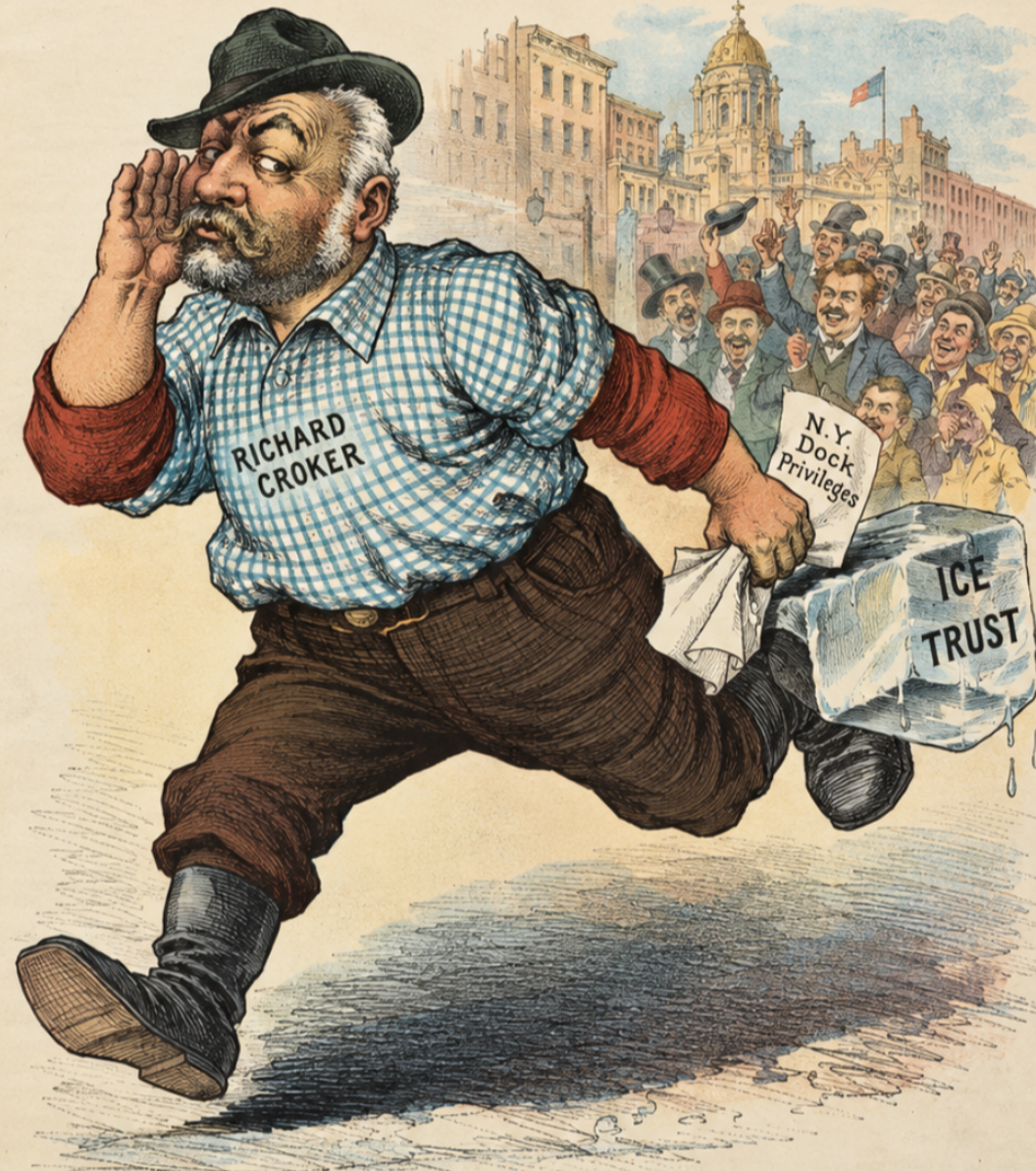
Illustration by S.D. Ehrhart published on cover of May 30, 1900, issue of Puck
The year is 1857, and 13-year-old Richard Croker, an Irish immigrant and school dropout, is working as an apprentice machinist in the New York Central & Harlem Railroad machine shops. He has just joined the Fourth Avenue Tunnel Gang, a group whose members dominated their territory by attacking and extorting teamsters and other workers that gathered around the Harlem line's freight depot on Fourth Avenue at 32nd Street.
The gang used the rail line and tunnels between 32nd and 41st streets as their hideout, where they could lie low, store contraband, and evade police. Fourth Avenue of the 1850s (now called Park Avenue) would be unrecognizable to us today. It was a sparsely populated shantytown. Grand Central Terminal did not yet exist.
Young Richard Croker developed a reputation as a ruthless bare-knuckle fighter and rose through the ranks to become gang leader at age 19. That same year, he joined one of the New York City Volunteer Fire Departments, working as an engineer for one of the engine companies. In those days, fire houses did double duty as political clubs and recruiters. This was Croker’s entry into public life and politics engaging with Tammany Hall.
Tammany Hall was an American political organization founded in 1786 as the Tammany Society. Tammany became the main local political machine of the Democratic Party and played a major role in controlling New York City and New York state politics. It could get out the votes because it functioned as an informal, highly efficient social safety net, long before state or federal welfare programs existed, providing job placement and patronage, emergency financial aid and basic relief, immigrant assimilation and legal assistance, social clubs and youth programs, and infrastructure improvements such as parks, schools, paved roads, street lighting and public baths.
But Tammany was known mostly for corruption, election fraud and graft. It relied on enforcers to control polling places.
Jimmy O'Brien, a Tammany alderman and ward boss, took notice after Croker won a boxing match against Dick Lynch, knocking out all of Lynch's teeth. Croker served as a hired tough and an election day "repeater" (illegally casting multiple ballots for Tammany candidates).
Croker moved up through the ranks as a Tammany loyalist. In 1868 to 1870, he was elected to the New York City Council as Alderman. He served as Coroner of New York County from 1873–1876. His career was not adversely affected when on Election Day, November 3, 1874, John McKenna was shot and killed during a violent street brawl between rival political factions at Second Avenue and 34th Street in Manhattan.
Croker was arrested and tried for the fatal shooting but later was released due to a hung jury. In the 1880s, he aligned himself with Tammany boss "Honest" John Kelly and was appointed City Fire Commissioner (1883–1887). He was appointed city Chamberlain (City Treasurer) from 1889 to 1900, as the country entered the Gilded Age.
From 1886-1902, Richard “Boss” Croker was head (Grand Sachem) of Tammany Hall. Critics of Tammany argued that Boss Croker ran the entire political machine like a "deluxe edition of the Fourth Avenue Tunnel Gang" — using extortion, physical intimidation, scams and patronage to maintain control and accumulate wealth. An associate described Croker as having "[a] strong frame, a deep chest, a short neck and a pair of hard fists ... He speaks in monosyllables, [and] commands a vocabulary that appears to be limited to about three hundred words.”
Croker’s greatest political success was the 1897 election of Tammany candidate Robert A. Van Wyck, first mayor of the five-borough "greater" New York, when Manhattan incorporated with Brooklyn and the other boroughs. After the election, Croker’s control spread to all five boroughs. During his tenure, Boss Croker continued his path of corruption and ruthlessness and was frequently the subject of investigations and condemnation from the public and the press. As head of Tammany, Croker received bribes and protection money from the owners of brothels, saloons and illegal gambling dens. He became a wealthy man from his businesses and illicit activities.
The Ice Trust Scandal of 1900 brought details of Croker’s business activities to light. He had received heavily discounted/gifted stock in the American Ice Company, which then proceeded to double the price of ice during a brutal summer heatwave, sparking massive public outrage over city officials profiting at the expense of low-income New Yorkers. Croker’s power waned following the 1900 and 1901 elections of reform candidates. He was never brought to justice for his corruption. Croker resigned his position and returned to Ireland, where he spent the rest of his life raising thoroughbred racehorses, two of which won The Derby. He died in 1922.
One of Croker’s critics was Rev. Charles Henry Parkhurst, an influential moral crusader and anti-corruption reformer in Gilded Age New York. Parkhurst is credited with contributing to Tammany Hall’s eventual demise. He was pastor of the prestigious Madison Square Presbyterian Church (located on Madison Avenue and 24th Street) from 1880 until 1918 and delivered passionate sermons against the corrupt Tammany Hall and NYPD.
In 1891, Parkhurst was named president of the New York Society for the Prevention of Crime. His personal investigations exposed widespread bribery and graft, directly leading to the 1894 election of reform mayor, William L. Strong and temporarily ousting Tammany Hall from power. Rev. Parkhurst lived at 133 East 35th Street (between Lexington and Park Avenue), in Murray Hill.
The ultimate decline of Tammany Hall was a gradual process that began in the 1930s and ended when the society was officially dissolved in 1967.
Two buildings in Murray Hill/Kips Bay have unique connections to Tammany Hall. The DeLamar Mansion at 233 Madison Avenue (landmarked in 1975) was built for Joseph Raphael De Lamar, who died in 1918. In 1923, the mansion was sold to the National Democratic Club, formerly the Democratic Club of the City of New York, for use as their headquarters. High-ranking Tammany figures used the club rooms so extensively for informal power-brokering, deal-making, and political strategizing that contemporary press and historians often referred to it as an informal extension or favored "hangout" of the Tammany machine. The current day use of the building since 1973 is to house the Consulate General of the Republic of Poland.
Tammany Hall clubhouse, 207 East 32nd Street. This building was originally completed in 1902 as a clubhouse for the Tammany Central Association, built as a replacement for its previous clubhouse at the same address. Headed by Richard Croker, the Tammany Central Association was one of Tammany Hall's local district organizations — at one point considered "the strongest district in Tammany." Croker resigned right around the time the building was completed, and the building was later leased to the city as a municipal courthouse from 1911 to 1939.
The building was converted into offices by the 1950s. In 1965 the building was purchased by graphic designers Milton Glaser and Seymour Chwast, who relocated their Push Pin Studios to the site.
The building served as the headquarters of New York magazine from the publication's founding in 1968 until 1974. Ms. magazine also began at this location in 1971, co-founded by Gloria Steinem. It was here that Glaser produced some of his most iconic work, including the ‘I ❤️ NY‘ logo. Glaser continued using the building as his studio until 2019. He died in 2020, and the building is now owned by The New York Review of Books.
— Nancy Idaka Sheran
